
HITRUST unifies regulatory and industry requirements for managing information risk and protecting sensitive data.
HITRUST ensures your organization meets the highest standards for protecting sensitive information. The CSF now harmonizes and maps over 50 authoritative sources, including HIPAA, ISO 27001, PCI DSS, NIST 800 series, GDPR, etc.
Based on 3 core principles, HITRUST was created to ensure the following:
HITRUST is a risk management framework, but it’s also an organization. The HITRUST Alliance is a private entity that created the Common Security Framework (CSF), a certifiable framework that integrates and harmonizes various standards and regulations. The Alliance also developed supporting certifications (e1, i1, r2, etc.) and the MyCSF® assessment platform, a tool designed to streamline evaluations and reporting.
At its core, HITRUST is an information protection standards organization and certifying body. Their mission is to champion programs that safeguard sensitive information and manage information risk for organizations across all industries throughout the third-party supply chain.
While the HITRUST CSF is industry-agnostic, it has become the gold standard for healthcare organizations seeking to demonstrate a serious commitment to security, privacy, and compliance.
HITRUST certification serves both as a recognized outcome and a powerful tool for demonstrating trust in an organization’s security and privacy practices. It provides third-party assurance to customers and stakeholders that appropriate safeguards are in place.
To achieve this certification, HITRUST offers three core types of assessments, each tailored to an organization’s size, risk profile, and assurance needs. All three assessment types are built on the HITRUST CSF, which integrates and harmonizes requirements from over 100 authoritative sources. These include HIPAA, NIST, COBIT, ISO 27001, SOC 2, and GDPR, combined into a single, scalable control framework. This allows organizations to address multiple compliance obligations through one comprehensive assessment.
The e1 assessment is the simplest of the three assessments. With 44 control requirements, the e1 assessment lets organizations quickly and efficiently receive a HITRUST certification. The e1 assessment confirms whether the control requirement statements have been implemented. The control requirements for the e1 demonstrate that your organization has reasonably achieved essential cybersecurity hygiene.
For the e1 assessment, both readiness and validated assessment options are possible. Many organizations think of the readiness assessment as a stepping-stone for the validated assessment. While there is no certification granted for the readiness assessment, we still generate a report that helps organizations identify and remediate gaps before performing a validated assessment. Upon completion of a validated assessment, a HITRUST certification is received.
Given the smaller scope of the e1 assessment, there is limited flexibility for the assessed entity. This is most evident when considering the fact that the certification only lasts 1 year. The assessed entity must also select the most current version of the e1 assessment that is available. Further, the assessed entity does not have the option to tailor the control requirements to cover privacy, information protection regulations (e.g., Health Insurance Portability and Accountability Act (HIPAA), General Data Protection Regulation (GDPR), Payment Card Industry Data Security Standard (PCI DSS), or the National Institute of Standards and Technology (NIST) Cybersecurity Framework). The e1 assessment lets your organization carve out service providers from testing.
The i1 assessment is an expansion of the e1 assessment. Covering 182 requirements, the i1 assessment includes the same 44 e1 control requirements, plus another 138. The i1 assessment provides a moderate level of assurance that your organization has implemented leading cybersecurity practices against a broader range of cyber threats when compared to the e1 assessment. Again, both readiness and validated assessment options are possible for the i1 assessment.
The i1 assessment offers some further flexibility than the e1 but share many of the same limitations. Like the e1, service providers can be carved out, and control requirements cannot be tailored to cover privacy, information protection regulations, or the NIST Cybersecurity Framework. Further, the certification for the validated assessment only lasts for 1 year.
Where the i1 offers greater flexibility is in the rapid recertification process. After your organization obtains the i1 certification, for the following year, you can be evaluated based on a selection of i1 requirement statements instead of being tested against all requirement statements again. This reduces the amount of testing required to complete the assessment.
The rapid recertification results in the same i1 assessment reports and i1 certification that is valid for one year. To use the rapid recertification process, there must not have been any significant changes to your organization’s control environment since the last i1 assessment. HITRUST defines a significant change as any of the following:
Acquisitions, divestures, mergers, or other changes in control of an Assessed Entity where controls over in-scope systems are no longer being operated by the Assessed Entity who originally obtained the certified report
Changes in a “Factor” question response within the validated assessment
Changes in responsibility for performance or oversight of the in-scope control activities (outsourcing, insourcing, or change in service providers)
Changing an in-scope system to use a different back-end system
Decommissioning a data center and moving all assets to a different data center
Moving an in-scope facility to a different physical location
Moving an on-premises data center to a public cloud environment
Moving away from an outsourced IT model by standing up an internal IT function
New functionality in an in-scope platform enabling it to be accessed from a public location
Replacing any of the in-scope platforms that were included in the previous i1 report
The r2 assessment is the most comprehensive of the three assessment types and offers the most flexibility. The r2 assessment encompasses the same control requirements as the e1 and i1 assessments, while also incorporating additional controls based on data volumes handled by your organization, applicable regulatory compliance, and other risk factors relevant to your organization.
Further, not only does the r2 assessment test the control requirement implementation status, but it also tests whether a policy or standard is in place for the control and whether the process supports the policy. There are 2 additional maturity levels that can be added as part of a r2 Assessment.
The first is “measured,” which looks at whether the control requirement is being tracked and tested by management to ensure the control is operating. The second is “managed,” which looks to see whether necessary corrective actions are being performed on the measured results. The r2 assessment provides a high level of assurance on the design and implementation of the leading cybersecurity practices and additional risk-based controls.
As a part of the further flexibility offered by the r2 assessment, the control requirements for the assessment can be tailored to cover privacy and information protection regulations. Upon receiving the r2 certification of a validated assessment, HITRUST will also issue your organization a certification over the NIST Cybersecurity Framework. Where flexibility is limited for an r2 assessment is that third party service providers cannot be carved out of testing.
Like the e1 and i1 assessments, the r2 offers both a readiness and validated assessment option type. It is not required for your organization to select the most current version of the r2 assessment at the time of assessment creation.
Due to the r2 being the most extensive assessment, the certification for the validated assessment lasts for 2 years, but an interim assessment is required after 1 year. The interim assessment takes 1 randomly selected requirement statement from each domain to be fully retested and rescored to ensure that certification requirements are maintained. The interim assessment also reviews any corrective action plans that were identified during the initial testing to ensure that issues were either remediated or that satisfactory progress has occurred.
The HITRUST Alliance’s Enterprise Strategy Group conducted a comprehensive analysis to calculate ROI, leveraging proprietary financial models, industry-standard methodologies, and customer-reported data.
The analysis applied conservative assumptions to assess the total cost of achieving HITRUST certification, including direct certification expenses and avoided costs. It also quantified a range of potential benefits, such as improved operational efficiency, reduced risk from fewer security breaches, enhanced regulatory compliance, minimized downtime, and incremental revenue opportunities driven by HITRUST certification. By capturing both cost savings and strategic value, the model attempts to provide a holistic view of HITRUST’s overall economic impact. Based on this approach, the Enterprise Strategy Group estimated a staggering 464% ROI for organizations that adopt the HITRUST certification framework.
Claim: HITRUST certification allows for avoided costs tied to discounted cyber insurance premiums, including not only lower annual insurance costs but also improved coverage quality and administrative efficiency.
Conclusion: Partially True. While exact savings may vary, a growing number of insurance providers, including direct partners of the HITRUST Alliance, are offering reduced premiums for organizations reaching certification in HITRUST r2 validated assessments. However, these discounts are not universally applied, and organizations should not assume automatic reductions. Actual savings will depend on the insurer, broker, industry risk posture, and scope of coverage.
Claim: Organizations with HITRUST certifications reported that HITRUST’s structured and comprehensive approach enabled them to reuse documentation across frameworks, minimizing duplication and reducing the effort required for additional assessments.
Conclusion: Partially True. The unique combination and consideration of multiple frameworks does make documentation associated with HITRUST certification easier to leverage efforts across other frameworks. This rings especially true for organizations utilizing GRC automation tools such as Vanta or Drata.
However, while HITRUST’s framework alignment can streamline evidence reuse, many customers and regulators still require organizations to maintain additional attestations or certifications such as SOC 2, PCI DSS, or ISO 27001. As a result, HITRUST certification alone does not necessarily eliminate the need for parallel compliance efforts, meaning efficiency gains are often incremental rather than absolute.
Claim: Customers with HITRUST certifications reported reduced breach-related costs, minimized regulatory penalties, and avoided downtime.
Conclusion: True.* These claims are true for any organization with an elevated security posture, not just those with a HITRUST certification. Previous HITRUST reports have indicated that less than 1% of HITRUST-certified organizations have fallen victim to a cyber event. However, the degree of risk reduction depends heavily on the level of certification pursued, ranging from the baseline e1 (44 requirements), to the more moderate i1 (182 requirements), up to the rigorous r2 assessment (average of ~289 requirements).
Each tier reflects a different depth of control maturity and assurance, and while higher-level certifications can provide stronger evidence of security and compliance, they also demand greater investment in time, cost, and operational discipline. Organizations should therefore view HITRUST as one component of a broader risk management strategy rather than a blanket guarantee of protection.
Claim: HITRUST certification led to indirect revenue gains, including faster sales cycles due to pre-validated security posture, competitive differentiation in regulated industries, and the ability to command premium pricing in certain contracts.
Conclusion: Plausible. This claim is the hardest to quantify; however, the logic is sound. HITRUST certification is an indication of a mature environment and that security is baked into the ethos of the organization. This will often lead to services or products being more marketable and will in-turn increase revenue. It’s kind of like a professional sports team upgrading its training facility. The facility doesn’t win games, but it shows commitment to excellence and attracts top recruits, which ultimately improves performance on the field.
Overall, the benefits outlined within the report are true for all organizations with an elevated security posture. In turn, achieving HITRUST certification does indicate a mature environment and that the organization is security minded. Even if ROI isn’t 464% as the report indicates, it would be hard to deny some of the value provided by the certification as outlined within the report.
Embarking on the journey toward HITRUST certification is a crucial step for any organization handling sensitive data, particularly within the healthcare sector. Achieving this benchmark demonstrates a commitment to robust information security and compliance.
Tip 1: Use What you Already Have in Place
A control overhaul might seem par for the course with each new control framework. With HITRUST, no need to reinvent the wheel, leverage the work your team already does. You likely already have controls in place, just not in HITRUST language.
Tip 2: Utilize Automation
Automation and repeatability are your best playing mates. Let them help you.
Tip 3: Assign Leaders for Each Step
Well defined and clearly communicated responsibilities help spread the load and prevent any scrambles to gather evidence or meet deadlines.
Tip 4: Build Your Program One Step at a Time
New frameworks can seem daunting – it’s important to remember that every course can be tackled with the right approach.
Tip 5: Bring in a Pro for the Tough Parts
Everyone’s program is different. Know when to consult your third-party or even have a expert build certain steps and processes for you.
Play the Long Game
Think of HITRUST as your goal; it takes stamina, coordination, and strategy. But with the right processes, your team can navigate it confidently without letting morale or leadership’s patience burn out.
Engaging a HITRUST-certified external assessor firm is an essential component of the certification process. In fact, it’s ultimately required to obtain a certification and validated assessment report. In our professional opinion, it should be the first course of action for an organization considering HITRUST.
Your external assessor should be your partner throughout your HITRUST journey, guiding you through the building remodel and beyond. They have the answers to the test that you ultimately have to take and will give you the answers to prepare for that test!
External Assessors are a professional service/consulting arrangement, so fees are based on the time and effort they expend. Fees can vary based on the assessment type, organizational size, and complexity of the systems in review.
These figures are starting points; actual costs may be higher depending on complexity and scope.
Pro Tip: Firms that are transparent about their fees should be able to help you realize discounts as you integrate automation into your control environment and mature your evidence collection and testing processes.
Access to the MyCSF platform is required for managing the certification process and submitting the validated assessment to HITRUST for QA validation and reporting. You will ultimately need to purchase both a professional subscription (annual) as well as a validated report agreement credit to access the platform.
The subscription level should align with your organization’s needs and the assessment type pursued.
Please note: Pricing estimates are for illustrative purposes only and subject to change. Official fees must be obtained directly from HITRUST.
Internal costs include staff time for preparation, remediation, and coordination:
Using a 100-person healthcare technology organization as an example, the internal effort required is a critical factor in achieving a successful certification outcome. On average, first-time certifications demand approximately the following internal FTE or contracted vendor hours:
Assuming the certification scope remains consistent, the internal effort typically decreases in year two and beyond as efficiencies are realized.
With the help of an experienced contractor, savings can be found and, as always, planning is key!
Implementing a phased approach allows organizations to tackle the certification process in manageable segments:
This structured method can lead to more efficient resource utilization and cost savings.
Work with your contractor to reduce manual control testing and develop custom automated control techniques. Additionally, consider utilizing compliance automation platforms, which can streamline evidence collection, control mapping, and reducing manual efforts and associated costs.
Clearly defining the scope of the assessment to include only necessary systems and processes can prevent unnecessary expenditures and focus efforts where they are most impactful.
Project costs add up fast, and it’s important to prepare stakeholders upfront.
Articulate the value of HITRUST certification in terms of risk mitigation, market competitiveness, and regulatory compliance to garner executive support.
Providing a comprehensive plan with projected costs and timelines can build confidence among stakeholders and facilitate resource allocation.
Emphasize how certification can lead to long-term savings by reducing the likelihood of data breaches and associated penalties.
Projects can be unpredictable, costly, and time-intensive. When working on new projects, that is even more so the case and, for that reason, it’s important to have a partner who has been there before. A partner that is open, honest, and upfront with everything will best prepare your project to proceed.
Certification requires a rigorous, evidence-based process that requires planning, cross-functional coordination, and genuine readiness. Certification isn’t simply given. It’s earned.
The journey through HITRUST certification is demanding, sometimes exhausting, often consuming, but it is also clarifying. It forces organizations to surface what was once hidden, to harden what was once fragile, to coordinate what was once fragmented. And when the final report is issued, those who have endured know they’ve done more than check the box, they’ve survived a campaign and earned a seal that speaks of both credibility and grit.
HITRUST has its own language and if you don’t speak it, you’re traveling abroad without a reliable translator. You wouldn’t want to be stuck in a foreign country without a card showing your hotel address in different languages, and you wouldn’t want to get caught roaming the vast lands of the HITRUST CSF without a HITRUST Authorized External Assessor.
After all, they’re the one who ultimately submits validated assessments to HITRUST for quality review. That means they know the answers to the test that you will have to pass to obtain certification. Engaging an external assessor firm early on in your journey will save you and your team days of wandering unfamiliar areas for a semblance of familiarity.
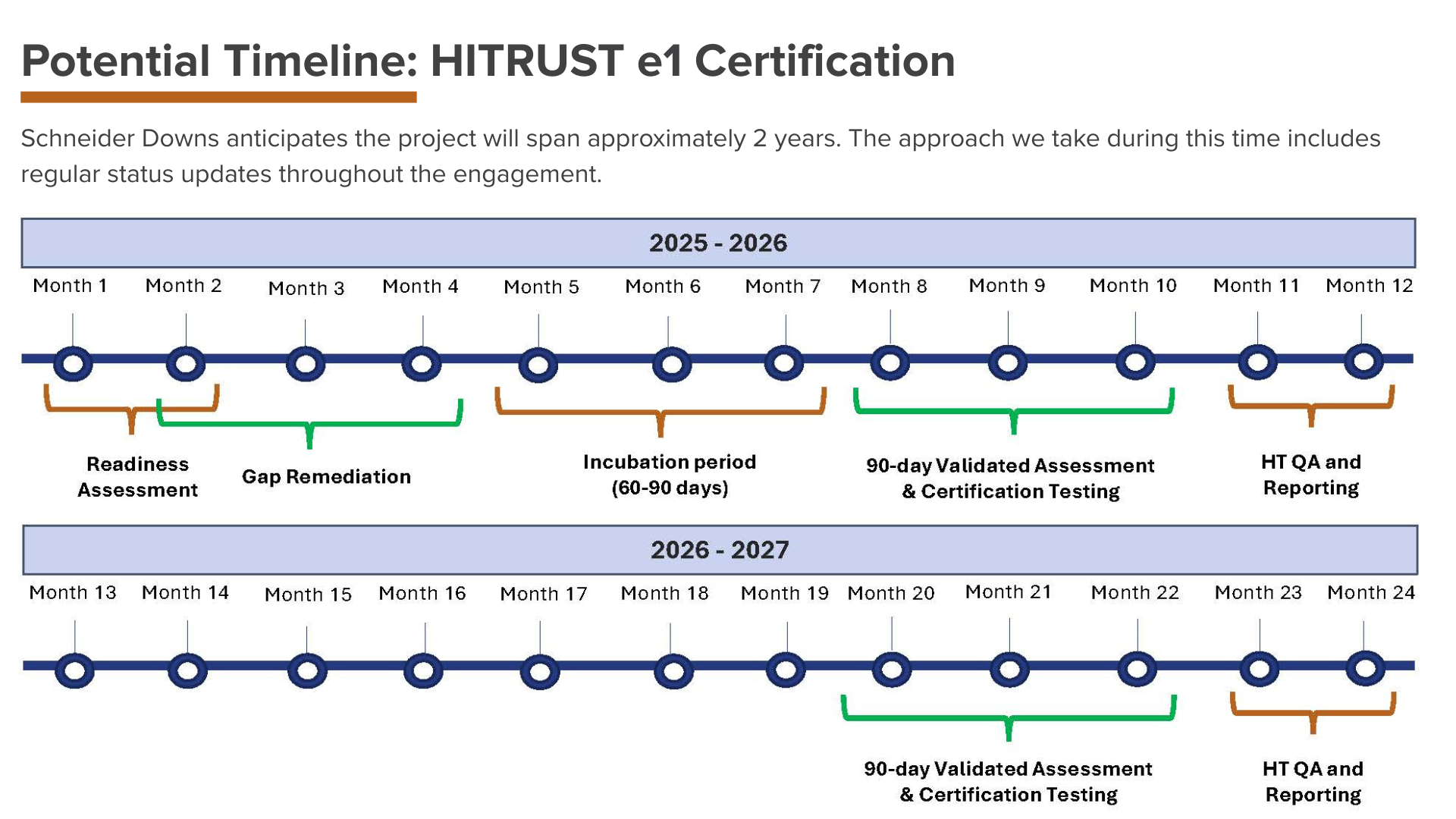
Phase Time Length: This phase is generally completed in a matter of weeks but does require some technical validation of your infrastructure and systems.
Before a validated assessment (certification), most organizations complete a readiness phase to:
Phase Time Length: This phase generally takes anywhere from 1 to 3 months, depending on the complexities of your infrastructure and systems.
This is where the heavy lifting happens. You’re now armed with the honey-do list of gaps to close, along with a prioritized roadmap. This phase is about executing the plan and checking back with your audit partner to ensure you did it the right way. In this phase, you will:
Once all of your readiness gaps have been closed and “implemented” (Congrats!) you get a free 90-day vacation. Well, sort of… HITRUST requires a 90-day “incubation period” for controls to be implemented (or 60 days for policies/procedures), before you can officially start your 90-examination period. In practice, you can begin that 90-day incubation clock as soon as the last gap is closed.
During this period of peace, it’s the perfect opportunity to book that HITRUST QA reservation. Once your assessment is scoped and loaded into MyCSF, you’ll be able to reserve a date on the HITRUST QA Team’s calendar, much like that of an online dinner reservation (the kind of one that takes your credit card preauthorization). This is a key step to ensure you meet your timeline as the HITRUST QA Team’s availability fluctuates based on demand. You don’t want to overpromise your delivery date if the QA team can’t meet your needs.
Additionally, the assessed entity can begin to work with the external assessor to preload MyCSF. While most of the controls will require time-stamped evidence from within your 90-day examination period, there’s still plenty your teams can do ahead of time to make the examination period run more smoothly. This includes tasks like:
The fog thickens, and the march turns into an open battle. This is the validated assessment, the clash of intent versus reality. Here, the External Assessor performs fieldwork and tests whether your claims survive contact with scrutiny.
This is no longer theory on paper. It is proof standing under fire. The validated assessment reveals not just the state of your controls, but the strength of your coordination under pressure.
With the assessment complete, the campaign now passes to final judgment. Your file advances to HITRUST, where a tribunal dissects *a sample of* every word, every score, every justification. This is the trial by fire, a distant but unyielding review where survival depends on precision.
Only when the defenses hold does the assessment move forward:
But the gauntlet is not finished. Reports must be drafted, revised, and approved:
This trial by fire is slow, relentless, and impartial. It demands not just accuracy, but endurance. The patience to close loop after loop until applicable weaknesses are fully understood.
Finally, the verdict: certification is granted… or… not. Regardless, a validated assessment report is published, with it’s certifying decision one way or the other. On the one hand, The Standard of Trust earned. On the other, Trust may cease to exist for now.
But the journey does not end here, it changes form. Certification is not a trophy to display; it is a banner raised over your organization, a signal to the market that you have endured and can be trusted.
Those who treat certification as a finish line often falter; those who treat it as a campaign standard to uphold lead their industries forward with credibility and strength. Certification is a call to remain vigilant, to adapt as threats evolve, and to prove, again and again, that trust is not a point in time, but a posture of resilience.
Let’s be honest. HITRUST is not a one-size-fits-all solution. But if you operate in healthcare or a related field, especially if you handle (e)PHI, it might be exactly the trust signal your organization needs. You should consider HITRUST if:
If you are considering HITRUST, start by evaluating your organization’s needs and the expectations of your clients. Engage stakeholders across departments to understand the scope and impact. HITRUST certification is a long-term investment. It requires coordination, a clear understanding of your risk environment, and ongoing commitment across internal and external teams. Approach it as a journey and trust the process.

As an Authorized HITRUST External Assessor Firm, Schneider Downs has a strong track record with HITRUST protocols, providing trusted guidance and support throughout the certification process. For more information, contact our HITRUST team at [email protected].
