This article is part of a series detailing the seven key steps to anticipate on the path to HITRUST certification. Check out the first article in the series here.
Into the Fog
You come out of incubation and the air is different. For months, your organization existed in relative calmness, with policies documented and acknowledged, configurations set and slept, and systems humming along in the background.
But now, the silence breaks and ahead lies a gauntlet of auditors and what seems like endless document requests.
What felt like routine governance suddenly reveals itself as a time-constrained campaign, and every decision, every document, and every test will determine whether you emerge with the standard of trust, or retreat with scars to repair.
This is the reality of the HITRUST certification journey; not a checklist to be idly marked, but a complex journey fought in phases. Strategy matters. Allies matter. Preparation matters. And survival, compliance, certification, and trust belong only to those who are willing to navigate through the fog with discipline and resolve.
The journey through HITRUST certification is demanding, sometimes exhausting, often consuming, but it is also clarifying. It forces organizations to surface what was once hidden, to harden what was once fragile, to coordinate what was once fragmented. And when the final report is issued, those who have endured know they’ve done more than check the box, they’ve survived a campaign and earned a seal that speaks of both credibility and grit.
Step 5: The Validated Assessment – The Battle of the CSF
The fog thickens, and the march turns into an open battle. This is the validated assessment, the clash of intent versus reality. Here, the External Assessor performs fieldwork and tests whether your claims survive contact with scrutiny.
- Performing Validation: The assessor validates pre-assessment scores, links required documents, executes the test plan, and completes the QA checklist. Time sheets, audit trails, and the representation letter become weapons and shields. This is where most of the hours are spent. Performing validation is the most grueling part of the campaign: assessors spend days and weeks combing through evidence, re-scoring pre-assessment judgments, and linking every screenshot, configuration, and attestation to the framework. The test plan drives hundreds of small exchanges, including requests for logs, clarification emails, system demos, and each one consumes time from both the assessment team and internal staff.
- Assessment Results Review: Once the bulk of validation is complete, the work shifts to the assessment results review. The entity and assessor sit shoulder-to-shoulder to acknowledge findings, accepting victories and recording wounds.
- Inputting Corrective Action Plans (CAPS) & Signing Rep Letter: CAPS are carved into the record, a pledge that gaps will not be left unguarded. The management representation letter is signed like a commander’s oath.
- Reviewing CAPs: The assessor validates these commitments, ensuring every promise is backed by real action.
This is no longer theory on paper. It is proof standing under fire. The validated assessment reveals not just the state of your controls, but the strength of your coordination under pressure.
Step 6: HITRUST Quality Assurance Review – Trial by Fire
With the assessment complete, the campaign now passes to final judgment. Your file advances to HITRUST, where a tribunal dissects *a sample of* every word, every score, every justification. This is the trial by fire, a distant but unyielding review where survival depends on precision.
- Performing Check-In: HITRUST performs automated quality assurance (QA) checks, scanning for inconsistencies in documents and evidence.
- Addressing Check-In Tasks: If issues arise, new tasks are hurled back like flaming arrows, the entity and assessor must respond timely.
- Reviewing Pending Check-In Tasks: HITRUST evaluates the fixes. If gaps remain, the engagement loops again until resolution.
Only when the defenses hold does the assessment move forward:
- Pending QA: The assessment sits in waiting, queued for its reserved QA block.
- Performing QA: The QA Analyst begins the full, impartial review of ratings, citations, and evidence under the microscope. This includes a review of a sample of control requirements in a live screen-sharing session with the External Assessor team. In this live session, the control references are randomly selected immediately before the call and the External Assessor team shares their screen and walks the HITRUST QA Analyst through each evaluative element and the associated evidence for each sampled control requirement.
- Escalated QA: If numerous and/or severe concerns are identified during QA, the Escalated QA phase will be triggered. This warrants an additional, internal review conducted by the HITRUST quality team and is more intensive than the standard QA process. Common reasons for Escalated QA include significant scoring inaccuracies, insufficient evidence to prove implementation, lack of rigor or testing inaccuracies, or extensive gaps.
- Addressing QA Tasks: More tasks may follow; remediation and clarification continue under fire. Only when every task is closed does the review advance.
But the gauntlet is not finished. Reports must be drafted, revised, and approved:
- HITRUST prepares and executives review the draft deliverables; the entity approves or requests revisions.
- Additional drafts, revisions, and reporting tasks cycle through until every open question is resolved.
This trial by fire is slow, relentless, and impartial. It demands not just accuracy, but endurance. The patience to close loop after loop until applicable weaknesses are fully understood.
Step 7: Certification & Beyond – The Standard of Trust
Finally, the verdict: certification is granted… or… not. Regardless, a validated assessment report is published, with it’s certifying decision one way or the other. On the one hand, The Standard of Trust earned. On the other, Trust may cease to exist for now.
But the journey does not end here, it changes form. Certification is not a trophy to display; it is a banner raised over your organization, a signal to the market that you have endured and can be trusted.
- Validity: 1 year for e1 and i1 and two for the r2. Interim reviews and recertifications loom on the horizon.
- Continuous Vigilance: New controls, new threats, new regulations will arise. Certification is not the end of war but the beginning of stewardship.
- Sustained Discipline: Prepare for each cycle as if it were your first; remediate continuously; embed resilience into the daily rhythm of operations.
Those who treat certification as a finish line often falter; those who treat it as a campaign standard to uphold lead their industries forward with credibility and strength. Certification is a call to remain vigilant, to adapt as threats evolve, and to prove, again and again, that trust is not a point in time, but a posture of resilience.
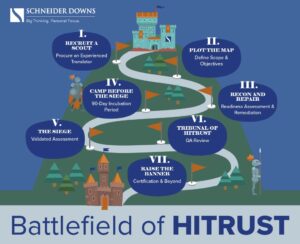
Final Thoughts – Epilogue: From the Fog to Watchtower
The fog lifts, the battlefield quiets, and what remains is not simply survival but transformation. Your organization has marched through the gauntlet, faced judgment, and emerged stronger. Certification is the seal, but the true victory is clarity: knowing your defenses, your gaps, your strengths, and your discipline.
From here, you take your place on the watchtower, bearing the Standard of Trust, not as a survivor of one campaign, but as a leader ready for the next.
How Can Schneider Downs Help?
As an Authorized HITRUST External Assessor Firm, Schneider Downs has a strong track record with HITRUST protocols, providing trusted guidance and support throughout the certification process. For more information, contact our HITRUST team at [email protected].
About Schneider Downs IT Risk Advisory
Schneider Downs’ team of experienced risk advisory professionals focus on collaborating with your organization to identify and effectively mitigate risks. Our goal is to understand not only the risks related to potential loss to the organization, but to drive solutions that add value to your organization and advise on opportunities to ensure minimal disruption to your business.
To learn more, visit our dedicated IT Risk Advisory page.